

Search engine optimisation, commonly called SEO, is the process of improving a website so that search engines can discover, understand and present its content to people searching for relevant information, products or services.
For a business, SEO can help potential customers find your website when they search for problems your company solves. A local customer may search for a service nearby, while an international buyer may compare products, platforms or professional providers before making a decision.
SEO is not simply adding keywords to a page or attempting to reach the first position on Google. It includes content quality, website structure, technical accessibility, page experience, local visibility, links, reputation and the usefulness of the information provided to visitors.
This guide explains what SEO is, how search engines work, the main types of SEO and why search engine optimisation can be important for business visibility, traffic, enquiries, sales and long-term growth.
Quick answer
SEO helps your business website become easier to discover through search engines. It is important because customers frequently search online before contacting a company, visiting a location or purchasing a product. Effective SEO can increase relevant visibility, attract potential customers, strengthen credibility and reduce complete dependence on paid advertising.
What Is SEO?
SEO stands for search engine optimisation. It refers to the work involved in helping search engines access, interpret and present a website’s content to users.
When someone searches for a product, service or answer, the search engine evaluates information from its index and attempts to provide useful results that match the query.
SEO improves the website’s opportunity to appear for relevant searches by making its content clearer, more useful and technically accessible.
SEO includes more than keywords
Keywords remain useful because they help businesses understand the language customers use. However, modern SEO extends beyond inserting exact phrases repeatedly into a page.
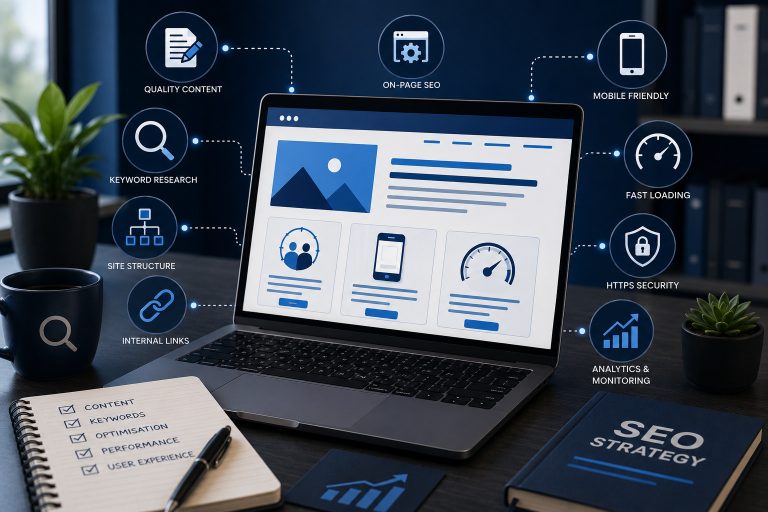
A complete SEO strategy may involve:
- Researching customer questions and search behaviour
- Creating useful pages and articles
- Organising website navigation
- Writing clear page titles and descriptions
- Improving mobile usability
- Making pages load efficiently
- Ensuring search engines can crawl important content
- Removing indexing problems
- Improving internal links
- Earning credible references and links
- Optimising local-business information
- Monitoring performance through analytics tools
SEO is both technical and strategic
Some SEO tasks involve code, server settings, redirects, structured data and indexing controls. Other tasks involve writing, branding, customer research, reputation and content planning.
Successful SEO normally requires these areas to work together rather than treating optimisation as one isolated plugin or setting.
A simple definition
SEO is the process of improving a website’s content, structure, accessibility and authority so that relevant people can discover it through search engines.
How Do Search Engines Work?
Understanding the basic search process makes SEO easier to understand.
Google describes Search as a fully automated system that uses web crawlers to discover pages. The general process involves crawling, indexing and serving search results.
1. Crawling
Search-engine crawlers follow links and other discovery signals to locate new and updated pages across the internet.
A crawler may discover your website through:
- Links from other websites
- Links between pages on your website
- An XML sitemap
- Previously known website pages
- Manual inspection tools
If important pages are not linked, are blocked incorrectly or return technical errors, search engines may struggle to access them.
2. Indexing
After discovering a page, the search engine analyses its text, images, videos, links and other information.
It may store information about the page in its index so that the content can be considered for relevant searches.
Not every crawled page is automatically indexed. Duplicate, low-value, inaccessible or technically problematic pages may be excluded.
3. Serving results
When someone searches, the search engine evaluates pages in its index and attempts to present results that are useful and relevant to the query.
Search systems may consider many signals rather than one fixed factor. A page does not rank simply because it contains a keyword more times than competing pages.
Search results can appear in different formats
Depending on the query, search results may include:
- Standard webpage listings
- Local map results
- Images
- Videos
- Products
- News
- Featured information
- Rich results
- AI-assisted search features
Publishing a page does not guarantee indexing or rankings
Search engines may discover a website automatically, but each page must still be accessible, useful and suitable for inclusion in search results.
Why Is SEO Important for a Business?
People use search engines when they need information, want to compare options or are preparing to make a purchase.
A business that does not appear during these searches may lose potential customers to competitors that are easier to find.
SEO connects your business with active demand
Social-media marketing often places content in front of people who were not actively looking for it.
Search traffic can be different because the user has already expressed an interest or need through the query.
Someone searching for a local website designer, an emergency plumber, a business consultant or an online course platform may be closer to taking action than someone casually scrolling through social media.
SEO helps your website work beyond business hours
An optimised website can be discovered at any time, including evenings, weekends and holidays.
Potential customers can read service information, compare options, submit forms or purchase products without waiting for the business to open.
SEO supports long-term digital visibility
A useful article or service page may continue attracting visitors after it is published.
This does not mean rankings remain permanently fixed. Competitors, search systems, customer behaviour and website quality can change. However, strong content can continue delivering value beyond one advertising campaign.
Why SEO matters
SEO helps your business appear when people are actively searching for information, products or services related to what you offer.
The Main Types of SEO
SEO is often divided into several categories. These categories overlap, but they help explain the different areas involved.
| SEO Type | Main Focus | Example Activities |
|---|---|---|
| On-page SEO | Individual webpage content and structure | Titles, headings, content, images and internal links |
| Technical SEO | Website accessibility and technical performance | Crawling, indexing, speed, mobile usability and redirects |
| Off-page SEO | External reputation and references | Links, mentions, digital PR and partnerships |
| Local SEO | Visibility for location-based searches | Business profiles, local pages, reviews and consistent details |
| Content SEO | Useful information matching audience needs | Service pages, guides, comparisons and resources |
| E-commerce SEO | Online-store visibility | Product pages, categories, product data and internal linking |
| International SEO | Multiple countries or languages | Language targeting, regional pages and alternate URLs |
Organic Search vs Paid Search Advertising
Organic search results and paid advertisements can both help businesses appear on search engines, but they operate differently.
Organic search
Organic listings are results selected by the search engine’s systems rather than placements purchased for each click.
SEO aims to improve a website’s eligibility, relevance and usefulness for these results.
Paid search advertising
Paid search allows advertisers to bid for placements associated with selected searches.
The business normally pays when users click or perform another defined action, depending on the campaign type.
SEO does not mean free marketing
Organic clicks do not usually require direct payment to the search engine, but SEO can still require investment in:
- Website design
- Technical development
- Content production
- Research
- Photography and media
- Professional tools
- Consulting
- Ongoing maintenance
SEO and paid search can work together
Paid advertising can generate visibility quickly, while SEO develops a stronger long-term search presence.
Advertising data can also help identify useful search terms, landing pages and customer behaviour.
| Area | SEO | Paid Search |
|---|---|---|
| Traffic source | Organic search results | Paid advertising placements |
| Speed | Usually develops gradually | Can begin generating traffic after launch |
| Cost model | Investment in content, technical work and strategy | Media spend plus management and creative costs |
| Duration | Strong pages may continue generating traffic | Traffic normally declines when spending stops |
| Control | Rankings and appearance are not guaranteed | Greater control over targeting and budget |
| Best use | Long-term visibility and authority | Immediate campaigns, testing and promotions |
The Main Business Benefits of SEO
1. Increased website visibility
SEO can improve your opportunity to appear for searches connected to your services, products, location and expertise.
Greater visibility means more potential customers may encounter your brand during their research.
2. More relevant website traffic
The objective is not simply to attract the largest possible number of visitors.
A smaller number of visitors who genuinely need your service can be more valuable than large volumes of unrelated traffic.
3. More leads and sales opportunities
Relevant visitors may:
- Submit an enquiry form
- Call your business
- Book an appointment
- Request a quotation
- Purchase a product
- Register for a course
- Join an email list
- Visit a physical location
SEO supports these outcomes by attracting suitable users and guiding them to useful landing pages.
4. Greater business credibility
A website that appears for useful industry searches can strengthen awareness and perceived expertise.
Helpful resources, accurate information, customer evidence and professional presentation can make visitors more comfortable contacting the business.
5. Reduced dependence on one marketing channel
A business relying entirely on advertising, social media or referrals may be vulnerable when costs, algorithms or customer behaviour change.
Search visibility adds another source of discovery and potential customers.
6. Better understanding of customer demand
Keyword research and Search Console data can reveal:
- Questions customers ask
- Services receiving interest
- Language used by potential buyers
- Locations generating searches
- Pages receiving impressions
- Topics with increasing demand
This information can support content, product, advertising and sales decisions.
7. Long-term return from useful content
A strong article, comparison or service page can continue supporting discovery after publication.
The content may require updates, but it is not limited to the lifespan of one social-media post or paid campaign.
8. Support for offline business activity
SEO is not only for online businesses. Customers frequently search before visiting physical shops, clinics, offices, restaurants and service locations.
The most important business benefit
SEO helps the right people find your business at the moment they are researching a need, service or purchasing decision.
Understanding Search Intent
Search intent describes what a user is trying to accomplish through a search query.
Understanding intent is essential because a page can mention the correct keyword and still fail to satisfy what the user needs.
Informational intent
The user wants to learn something.
Examples include:
- What is SEO?
- How does web hosting work?
- What is the difference between WordPress.com and WordPress.org?
Commercial investigation
The user is comparing options before making a decision.
Examples include:
- Best website builders for small businesses
- Shopify vs WooCommerce
- Managed hosting vs shared hosting
Transactional intent
The user is preparing to take an action such as purchasing, booking or registering.
Examples include:
- Hire a WordPress designer
- Buy web hosting
- Book an SEO consultation
Navigational intent
The user wants to reach a particular website, company or webpage.
Examples include:
- Google Search Console login
- Teemikemedia contact page
- Shopify pricing
Local intent
The user wants a business, service or location within a particular area.
Examples include:
- Website designer near me
- Restaurant in Akure
- Business consultant in London
Do not force one page to satisfy every intent
A detailed educational guide, service page and product page serve different purposes. Create the type of page that genuinely matches the searcher’s need.
What Are Keywords in SEO?
Keywords are words and phrases people use when searching for information.
Keyword research helps a business understand customer language and identify topics worth addressing.
Short keywords
Short phrases such as “SEO” or “web hosting” can have broad meaning and strong competition.
Long-tail keywords
Longer phrases such as “how to choose hosting for a small business website” are usually more specific.
They may have lower individual search volume but clearer intent.
Branded keywords
These include a company, product or personal name.
Examples include searches for your agency name, a particular platform or a specific service package.
Local keywords
These combine a service with a location or local intention.
Examples include “website designer in Akure” or “accountant near me.”
Keywords should guide content, not damage it
Use relevant language naturally in titles, headings, page content and links.
Repeating a phrase unnaturally can make content difficult to read and does not guarantee stronger rankings.
Keyword principle
Use keyword research to understand the audience, then create the most useful page for the underlying need.
What Is SEO Content?
SEO content is information created to help users while remaining accessible and understandable to search engines.
It may include:
- Service pages
- Product pages
- Category pages
- Blog articles
- Comparisons
- Buying guides
- Case studies
- Frequently asked questions
- Location pages
- Videos and transcripts
- Research and original data
- Tools and calculators
People-first content
Google recommends creating helpful, reliable content primarily for people rather than producing pages mainly to manipulate search visibility.
Useful business content should be:
- Accurate
- Relevant
- Clear
- Original where possible
- Written for the intended audience
- Supported by genuine experience or expertise
- Updated when information changes
- Easy to navigate
Content should demonstrate real business knowledge
A website-design agency can publish practical platform comparisons, hosting guidance, SEO advice, case studies and answers based on real client experience.
This is more valuable than publishing generic articles unrelated to the company’s services.
Content quality matters more than frequency alone
Publishing every day does not guarantee results. One well-researched article may provide more value than several thin or repetitive posts.
Do not publish content only because a keyword exists
Create content when your business can offer a useful, accurate and relevant answer to the searcher’s question.
What Is On-Page SEO?
On-page SEO focuses on the information and HTML elements found on an individual webpage.
Page titles
The title should clearly explain the main subject of the page.
Each important page should normally have a distinct and descriptive title.
Headings
Headings organise the content into logical sections and help readers scan the page.
A page should use headings according to structure rather than selecting them only for visual size.
Body content
The content should address the main topic thoroughly without unnecessary repetition.
URLs
URLs should be understandable, stable and related to the content where practical.
Image optimisation
Images should have useful filenames, appropriate dimensions and descriptive alternative text where needed.
Internal links
Internal links connect related pages within your website.
They help visitors continue their journey and help search engines discover and understand website relationships.
External references
Links to trustworthy sources can help readers verify information and explore a subject further.
Structured data
Structured data is machine-readable markup that can help search engines understand certain types of page information.
Correct implementation can make eligible content available for richer search appearances, but it does not guarantee that a rich result will be shown.
On-page SEO goal
Make every important page clear, useful, well organised and relevant to the search intent it is designed to satisfy.
What Is Technical SEO?
Technical SEO focuses on whether search engines can access, process and understand the website efficiently.
Important technical SEO areas include:
- Crawl accessibility
- Indexing controls
- XML sitemaps
- Canonical URLs
- Redirects
- HTTP status codes
- HTTPS
- Mobile usability
- Website speed
- Structured data
- JavaScript rendering
- Duplicate-content management
- International targeting
- Server reliability
Crawling controls
A robots.txt file can guide crawler access to parts of the website. It should not accidentally block important pages or website resources.
Indexing controls
Meta robots directives and other controls can indicate whether pages should be considered for indexing.
Incorrect settings can remove important pages from search visibility.
Canonical URLs
A canonical signal can help identify the preferred version when similar content is available through multiple URLs.
Redirects
Redirects guide users and search engines from an old URL to a relevant new location.
Broken or excessive redirect chains can create usability and crawling problems.
HTTPS
HTTPS encrypts information exchanged between the website and the visitor’s browser.
Mobile usability
The website should remain readable and functional on mobile devices without forcing users to zoom, scroll horizontally or interact with tiny controls.
Technical SEO cannot replace useful content
A technically perfect website will not automatically perform well when its pages provide little value or fail to match customer needs.
What Is Off-Page SEO?
Off-page SEO refers to signals and activity outside your website that can affect awareness, reputation and authority.
Links from other websites
Links can help search engines discover pages and understand relationships across the web.
A relevant link from a credible organisation can also send referral visitors directly to your website.
Digital public relations
News coverage, interviews, research, community work and useful industry resources can generate mentions and links naturally.
Business directories
Relevant and reputable directories can help customers confirm business information and discover services.
Partnerships and associations
Suppliers, professional bodies, chambers of commerce and project partners may provide legitimate references to your website.
Avoid manipulative link schemes
Buying large numbers of unrelated links, using automated link networks or exchanging links excessively can create risk rather than sustainable visibility.
Off-page SEO principle
Build real reputation and relationships that would still be valuable even if search rankings were not involved.
What Is Local SEO?
Local SEO helps businesses become more visible to people searching within a particular geographic area.
It is especially important for:
- Restaurants
- Clinics
- Law firms
- Estate agents
- Gyms
- Retail shops
- Tradespeople
- Local consultants
- Home-service businesses
- Hospitality companies
Google Business Profile
An accurate business profile can help the company appear across Google Search and Maps.
Important information may include:
- Business name
- Address or service area
- Telephone number
- Opening hours
- Business category
- Website
- Services
- Photographs
- Customer reviews
Consistent business details
The business name, contact information and location details should remain consistent across the website and trusted directories.
Location pages
A business serving several genuine locations may create useful pages explaining the services available in each area.
Do not create hundreds of nearly identical location pages with only the town name changed.
Customer reviews
Reviews can influence customer confidence and provide feedback about the business experience.
Local SEO goal
Help nearby customers find accurate information about your business and confidently take the next step.
What Is E-Commerce SEO?
E-commerce SEO focuses on improving the visibility and usability of online-store pages.
Important e-commerce page types include:
- Product pages
- Product-category pages
- Brand pages
- Buying guides
- Comparison pages
- Shipping information
- Returns information
- Frequently asked questions
Product descriptions
Descriptions should provide information customers genuinely need rather than copying identical manufacturer text across many stores.
Product images
Images should be clear, compressed appropriately and supported by useful alternative text where relevant.
Product structured data
Eligible product information can be marked up to help search engines understand details such as price, availability and ratings.
Category organisation
Products should be grouped in ways that make sense to customers and support clear internal navigation.
Out-of-stock products
The store should have a planned approach for temporarily unavailable and permanently discontinued products.
Duplicate filters and parameters
Filtering, sorting and tracking parameters can create many similar URLs. These require careful technical management.
E-commerce SEO goal
Help customers discover suitable products, understand their options and complete purchases through clear, accessible store pages.
How User Experience Supports SEO
SEO and user experience are closely connected because search visibility has little business value when visitors cannot use the website effectively.
Clear navigation
Visitors should understand where they are and how to reach important services, products and contact information.
Readable content
Use clear typography, suitable spacing, descriptive headings and manageable paragraph lengths.
Mobile-friendly design
Forms, menus, buttons, tables and images should work properly on smaller screens.
Page performance
Large images, excessive scripts, weak hosting and heavy design effects can make a website slower.
Accessible design
Websites should support users with different abilities through semantic structure, keyboard access, readable contrast and descriptive alternatives for meaningful images.
Clear calls to action
Visitors should know how to contact the business, request a quotation, purchase a product or book an appointment.
Traffic alone is not the goal
A website that receives visitors but fails to answer their questions or support the next step is not delivering strong business value.
How Do You Measure SEO Performance?
SEO should be measured using business outcomes and search-performance data rather than relying only on one keyword position.
Google Search Console
Search Console helps website owners understand how their sites perform in Google Search.
The performance reports can show:
- Clicks
- Impressions
- Average search position
- Click-through rate
- Search queries
- Performing pages
- Countries
- Device types
- Search appearances
Website analytics
Analytics tools can help measure what visitors do after arriving on the website.
Useful actions may include:
- Form submissions
- Telephone-number clicks
- Appointment bookings
- Product purchases
- Account registrations
- Course enrolments
- Email subscriptions
- Downloads
Keyword visibility
Tracking tools can help monitor whether pages are gaining or losing visibility for relevant search themes.
Individual rankings fluctuate, so broader trends are normally more useful than checking one phrase repeatedly.
Organic conversions
The most important measurement is often whether organic visitors become enquiries, customers or subscribers.
Revenue and lead quality
A business should evaluate the quality and value of SEO-generated opportunities rather than celebrating traffic that produces no meaningful outcome.
Measurement principle
Track visibility, traffic and rankings, but connect them to enquiries, sales and other outcomes that matter to the business.
How Long Does SEO Take?
SEO does not have one guaranteed timeline.
Results depend on:
- The age and condition of the website
- Competition
- Industry and location
- Current authority
- Technical problems
- Content quality
- Publishing consistency
- Website reputation
- Available resources
- The type of search query
New websites may require more time
A new domain normally has limited content, few external references and little historical performance data.
Existing websites can sometimes improve faster
A well-established website may see gains after fixing indexing problems, improving important pages or consolidating weak content.
Competitive searches take longer
A local specialised service may have fewer competitors than a broad international finance, insurance or software keyword.
SEO is cumulative
Technical improvements, useful content, internal links and reputation can build value over time.
Avoid guaranteed ranking timelines
No ethical SEO professional can guarantee a particular position by a fixed date because search results depend on systems and competitors outside their control.
Common SEO Mistakes Businesses Make
1. Building a website without keyword or audience research
The business may use internal terminology that customers never search for.
2. Creating one page for every possible keyword variation
This can produce thin, repetitive pages that compete with one another.
3. Publishing generic content
Articles that repeat information found everywhere else may provide little reason for visitors or search engines to prefer the page.
4. Ignoring technical problems
Incorrect indexing settings, broken links, server errors and poor redirects can prevent useful pages from performing properly.
5. Neglecting mobile users
A website that works only on desktop can lose a substantial part of its audience.
6. Buying low-quality links
Artificial links can create risk and usually provide little genuine referral or brand value.
7. Using misleading page titles
A title should accurately represent the page rather than making promises the content does not fulfil.
8. Forgetting conversion optimisation
Organic traffic cannot produce business value when the website lacks clear contact, booking or purchasing options.
9. Failing to update outdated information
Old prices, discontinued services and outdated platform features can damage trust.
10. Measuring only rankings
A top position for an irrelevant query may provide less value than lower visibility for a phrase that generates qualified customers.
11. Expecting immediate results
Businesses may abandon a sound strategy before content and technical improvements have had enough time to develop.
12. Treating SEO as a one-time plugin installation
An SEO plugin can help manage metadata and technical settings, but it cannot replace research, content, website quality and ongoing improvement.
What SEO Cannot Guarantee
SEO can improve a website’s search opportunity, but it cannot guarantee every result a business may expect.
SEO cannot guarantee first position
Search results are selected by automated systems, and competing websites continue improving their content.
SEO cannot guarantee immediate sales
Traffic still depends on pricing, reputation, offers, website design, customer trust and sales processes.
SEO cannot permanently secure rankings
Search behaviour, competitors, content and search systems can change.
SEO cannot rescue a weak business offer alone
Optimisation can attract visitors, but it cannot make an unsuitable product, unclear service or poor customer experience successful.
SEO cannot replace website maintenance
Broken forms, expired domains, malware and slow hosting can undermine search visibility and conversions.
A realistic SEO promise
SEO can improve discoverability, relevance and website quality, but responsible professionals should not promise guaranteed rankings or revenue.
Does Your Business Need an SEO Professional?
A small business can complete some basic SEO independently, especially when the website is simple and competition is modest.
You may manage SEO internally when:
- Your website is small
- You have time to learn
- You understand your customers well
- You can create useful content
- You can manage basic website settings
- Your market has limited competition
Professional help may be valuable when:
- The website has indexing problems
- Organic traffic has declined
- The business operates in a competitive market
- You are redesigning or migrating the website
- You need a content strategy
- You have multiple locations
- You run a large online store
- You need technical SEO work
- You lack time or internal expertise
- Search visibility is commercially important
Questions to ask an SEO professional
- How will you learn about our customers and business?
- What technical issues will you review?
- How will you measure success?
- What work will be completed each month?
- Who owns the content and accounts?
- Will you need website access?
- Do you guarantee rankings?
- How do you approach links?
- How will you report changes?
Be cautious with guaranteed rankings
A provider promising instant first-page positions, secret relationships with Google or thousands of automated links may expose your website to unnecessary risk.
How to Get Started with SEO
Step 1: Define your business goals
Decide whether SEO should generate service enquiries, appointments, product sales, course enrolments, store visits or brand awareness.
Step 2: Identify your audience
Understand who they are, what problems they face and how they describe those problems.
Step 3: Audit the website
Review:
- Indexing
- Navigation
- Page titles
- Content quality
- Mobile usability
- Website speed
- Broken links
- Forms and conversions
- Local-business information
- Analytics setup
Step 4: Research topics and keywords
Identify service searches, customer questions, comparison searches and local phrases connected to your business.
Step 5: Improve essential business pages
Begin with the homepage, service pages, product categories, contact page and important location pages.
Step 6: Create useful supporting content
Publish guides, comparisons, case studies and answers that support the customer’s decision-making process.
Step 7: Strengthen internal linking
Connect related articles to service and product pages using descriptive links.
Step 8: Set up Google Search Console
Use Search Console to understand crawling, indexing, queries, pages, clicks and impressions.
Step 9: Measure conversions
Track whether organic visitors submit forms, call, purchase or complete other valuable actions.
Step 10: Review and improve
Update important pages, fix technical problems and expand content based on performance and customer needs.
Business SEO Checklist
Website SEO checklist
- Website uses HTTPS
- Important pages are indexable
- Navigation is clear
- Page titles are descriptive
- Headings follow a logical structure
- Images are optimised
- Mobile layout works properly
- Forms and buttons function
- Broken links are repaired
- XML sitemap is available
- Search Console is connected
- Analytics and conversions are configured
Content SEO checklist
- Audience is clearly defined
- Search intent is understood
- Important services have dedicated pages
- Content answers genuine questions
- Claims are accurate
- Outdated information is updated
- Related pages are internally linked
- Calls to action are clear
- Local information is consistent
- Content demonstrates real expertise
- Duplicate pages are avoided
- Performance is reviewed regularly
Final Verdict: Is SEO Important for Your Business?
SEO is important for businesses whose customers use search engines to find information, compare options and make purchasing decisions.
It can improve website visibility, attract relevant visitors, support credibility and generate leads or sales beyond the lifespan of one advertising campaign.
Effective SEO involves more than keywords. It requires helpful content, clear website structure, technical accessibility, strong user experience, accurate business information and ongoing measurement.
SEO is not an instant or guaranteed method of reaching first position. Results depend on competition, website quality, authority, customer demand and the consistency of the work.
A business should approach SEO as a long-term investment in making its website easier to discover and more useful to potential customers.
Our recommendation
Begin with a technically sound website, clear service pages and useful content based on real customer needs. Measure clicks, enquiries, sales and other business outcomes rather than focusing only on rankings.
Frequently Asked Questions
What does SEO mean?
SEO means search engine optimisation. It is the process of improving a website so search engines can discover, understand and present its content for relevant searches.
Why is SEO important for a business?
SEO can help potential customers find a business when they search for relevant information, products or services. It can support visibility, website traffic, enquiries, sales and credibility.
How does SEO work?
SEO improves website content, structure, technical accessibility and external reputation so that search engines can crawl, index and evaluate important pages more effectively.
Is SEO free?
Organic clicks do not usually require direct payment to the search engine, but SEO may require investment in content, website development, tools, research and professional support.
How long does SEO take?
There is no fixed timeline. Results depend on competition, website condition, content quality, authority, technical issues and the resources invested.
Can SEO guarantee first position on Google?
No. Search rankings are controlled by automated systems and can change. Responsible SEO professionals should not guarantee a specific permanent position.
What is on-page SEO?
On-page SEO involves improving individual pages through titles, headings, content, images, internal links and other elements found on the webpage.
What is technical SEO?
Technical SEO focuses on crawling, indexing, website speed, mobile usability, HTTPS, redirects, structured data and other technical website systems.
What is local SEO?
Local SEO improves visibility for location-based searches through accurate business information, local pages, business profiles, reviews and relevant local references.
What is off-page SEO?
Off-page SEO involves external signals such as credible links, mentions, partnerships, reviews and digital public relations that support reputation and discovery.
Does every business need SEO?
SEO is valuable when customers use search engines to discover or evaluate the business. Some companies may prioritise referrals, direct sales or other channels, but most professional websites benefit from basic search optimisation.
Can I do SEO myself?
Yes. Business owners can learn basic keyword research, page optimisation, content creation and Search Console. Complex technical issues or competitive markets may require professional support.
Do I need an SEO plugin?
An SEO plugin can simplify metadata, sitemaps and other settings on platforms such as WordPress. It does not replace useful content, technical quality, keyword research or reputation building.
Is blogging required for SEO?
Not every business must publish frequently, but useful articles can target informational and comparison searches that service or product pages may not cover.
Does social media improve SEO?
Social media can increase content exposure, brand awareness and referral traffic. Social engagement does not automatically guarantee higher search rankings.
How do I know whether SEO is working?
Monitor Search Console impressions and clicks, organic website traffic, enquiries, calls, purchases and other conversions connected to search visitors.
Need Help Improving Your Website’s Search Visibility?
A professional website should do more than look attractive. It should be technically sound, easy to navigate and structured around the information your potential customers are searching for. Teemikemedia Agency helps businesses improve website structure, on-page SEO, content, technical foundations and search visibility.
Official references
This article was prepared using current guidance from Google Search Central. Search systems and supported features can change, so review current official documentation when making technical decisions.
Creating helpful, reliable, people-first content
Getting started with Google Search Console
Google Search Console performance report