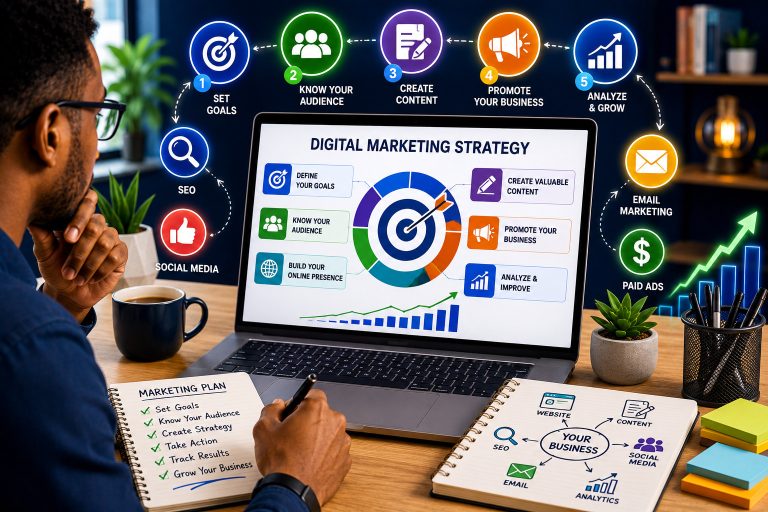
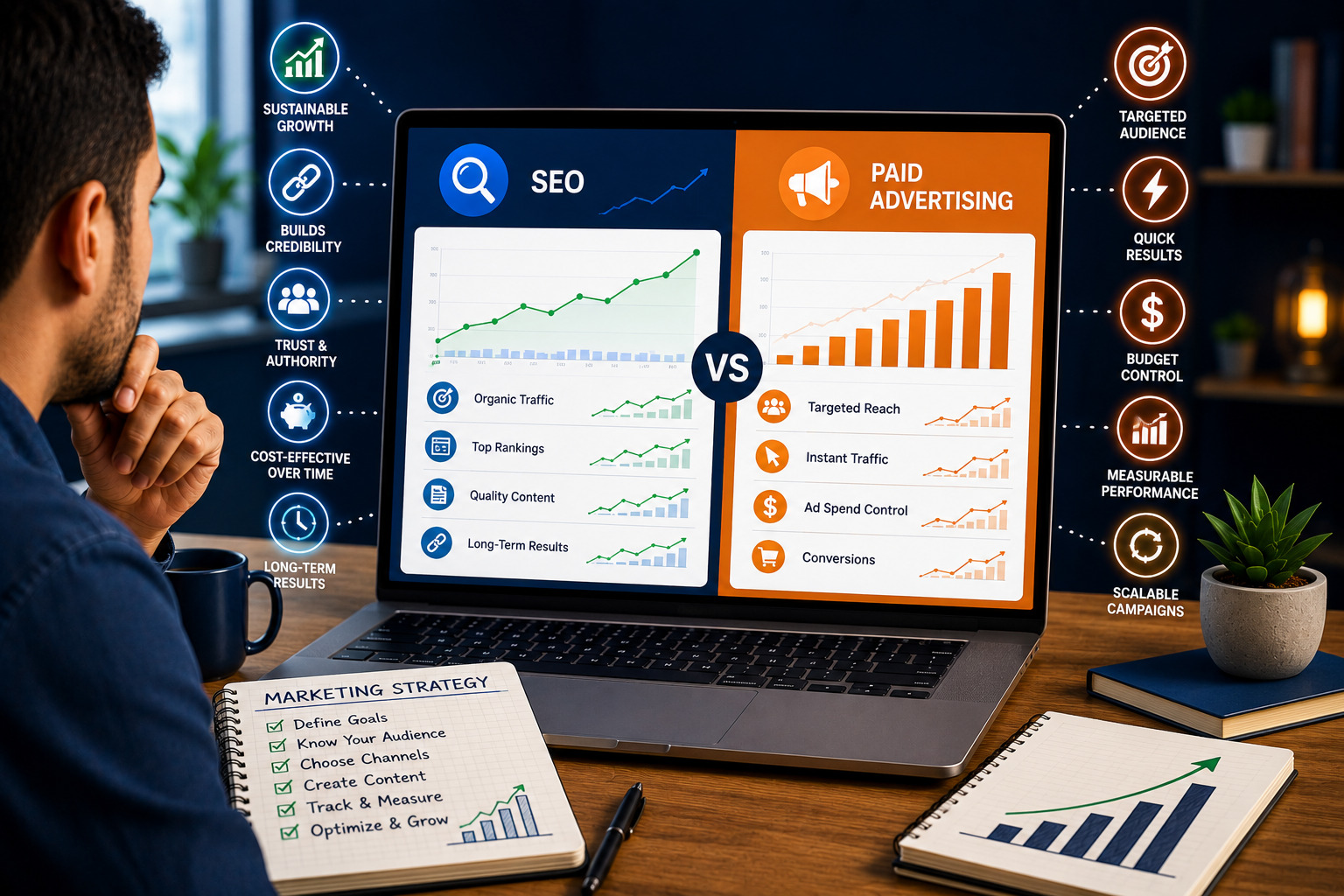

Choosing between SEO vs paid advertising for business growth is one of the most common marketing decisions for small businesses, startups and service providers. Both can help your business attract customers online, but they work in very different ways.
Search engine optimization helps your website earn visibility in organic search results by improving content, technical structure, user experience and authority over time. Paid advertising helps your business reach targeted audiences quickly by paying to show ads on search engines, social platforms, websites, apps or video platforms.
The best choice depends on your goals, budget, timeline, market, offer, website quality and ability to measure results. In many cases, the strongest growth strategy uses both SEO and paid advertising together instead of treating them as enemies.
This guide compares SEO and paid advertising across speed, cost, trust, targeting, scalability, risk, measurement and long-term business growth.
Quick answer
SEO is usually better for long-term, compounding growth because it can attract organic traffic over time without paying for every click. Paid advertising is usually better for fast visibility, testing offers and generating traffic quickly. For most serious businesses, the best approach is to use paid ads for speed and data while building SEO for durable long-term growth.
Important note
Neither SEO nor paid advertising guarantees business growth by itself. Your website, offer, landing page, follow-up process, pricing, trust signals and conversion tracking all affect whether traffic turns into enquiries, sales or customers.
What Is SEO?
SEO stands for search engine optimization. It is the process of improving your website so search engines can understand your content and users can find your pages when they search for relevant topics, services or products.
SEO involves several areas:
- Keyword research
- Helpful content creation
- Technical website improvements
- Website speed and mobile usability
- Internal linking
- Image optimization
- Structured website navigation
- Backlinks and authority building
- Local SEO where relevant
- Search Console monitoring
Google’s own SEO Starter Guide explains SEO as helping search engines understand your content and helping users find your site through search engines.
How SEO supports growth
SEO supports growth by making your website easier to discover when potential customers are already searching for information, comparisons, solutions or services related to your business.
For example, a website design agency may target topics such as website maintenance, WordPress security, website redesign, SEO basics, ecommerce platforms and online course platforms. Over time, these articles can attract visitors who later become leads.
What Is Paid Advertising?
Paid advertising is a digital marketing method where a business pays to show ads to a selected audience. This may happen on search engines, social media platforms, websites, mobile apps, video platforms or other ad networks.
Common types of paid advertising include:
- Google Search ads
- Display ads
- YouTube ads
- Facebook and Instagram ads
- LinkedIn ads
- TikTok ads
- Remarketing ads
- Shopping ads
- Sponsored content
Google describes Google Ads as an online advertising program that allows businesses to create ads to reach people when they are interested in the products and services being offered.
How paid advertising supports growth
Paid advertising supports growth by giving a business immediate visibility. Instead of waiting for organic rankings to build, you can launch a campaign, target a specific audience and begin testing traffic, offers and landing pages quickly.
SEO vs Paid Advertising: Quick Comparison
| Area | SEO | Paid Advertising |
|---|---|---|
| Speed | Usually slower to show results | Can generate traffic quickly |
| Cost model | Requires investment in content, website quality and optimization | Requires ongoing ad spend |
| Traffic duration | Can continue after content ranks | Usually stops when ads stop |
| Trust | Organic visibility can build credibility | Ads can work well but may be recognized as sponsored |
| Targeting | Targets search intent through content | Targets keywords, audiences, interests and behaviours |
| Testing | Slower testing cycle | Faster testing cycle |
| Long-term value | Strong compounding potential | Strong when campaigns are profitable and managed well |
| Best for | Long-term visibility, authority and lower dependency on ads | Fast visibility, lead generation, promotions and offer testing |
1. Speed of Results
Paid advertising usually wins on speed. A campaign can start showing ads soon after setup, review and approval. This makes paid ads useful when a business needs quick visibility, fast testing or immediate traffic.
SEO usually takes longer because search engines need time to discover, crawl, understand and rank your content. Google notes that changes made to a website can take time to be reflected in search results, and some changes may take weeks or months to evaluate properly.
Choose paid ads for speed when:
- You are launching a new product or service
- You need leads quickly
- You want to test a landing page
- You are running a limited-time campaign
- You are entering a competitive market
- You need traffic before SEO matures
Choose SEO for sustainable discovery when:
- You want long-term search visibility
- You can publish helpful content consistently
- You want to reduce long-term dependency on ads
- Your audience searches for educational topics
- Your website can become a trusted resource
2. Cost and Budget Control
Paid advertising gives you direct control over daily or campaign budgets. You can choose how much to spend, where ads appear and which audiences or keywords you target. Google Ads also allows advertisers to set and control their own budgets without a minimum spending commitment.
However, paid advertising can become expensive if campaigns are not monitored. You may pay for clicks that do not convert, audiences that are too broad or landing pages that fail to turn visitors into customers.
SEO does not usually charge you per click, but it still costs money, time or effort. You may need to invest in content writing, technical SEO, website speed, design, research, tools and ongoing updates.
Paid advertising costs may include:
- Ad spend
- Campaign setup
- Creative design
- Copywriting
- Landing page design
- Campaign management
- Tracking setup
SEO costs may include:
- Keyword research
- Content creation
- On-page optimization
- Technical SEO
- Website improvements
- Internal linking
- Content updates
- Analytics and Search Console monitoring
3. Trust and Credibility
SEO can build credibility because organic results are earned rather than directly bought. When a business appears repeatedly for useful searches, customers may begin to view the brand as helpful and knowledgeable.
Paid ads can also build trust when the message, offer and landing page are strong. However, ads are clearly sponsored placements, and some users may prefer organic results depending on their intent and awareness.
SEO credibility comes from:
- Helpful content
- Clear expertise
- Strong internal linking
- Trustworthy website design
- Useful comparison articles
- Consistent publishing
- Updated information
Paid advertising credibility comes from:
- Relevant ad copy
- Clear offer
- Professional landing page
- Social proof
- Transparent pricing
- Good reviews
- Strong follow-up process
4. Targeting and Reach
Paid advertising offers strong targeting options. Depending on the platform, you may target by keyword, location, device, demographics, interests, behaviours, remarketing lists or customer data.
SEO targets intent through content. Instead of selecting people directly, you create pages that match what people search for. This is powerful when your audience uses search engines to research solutions, compare options or learn how to solve a problem.
Paid ads are strong for targeting:
- Specific locations
- Specific demographics
- Specific interests
- People who visited your website before
- Searchers using commercial keywords
- Lookalike or similar audiences
SEO is strong for search intent:
- Informational searches
- Comparison searches
- Problem-solving searches
- Local service searches
- Product research
- Long-tail keywords
5. Traffic Quality
Traffic quality depends on matching the right message with the right person at the right stage of the customer journey.
SEO traffic can be highly valuable when a page matches clear search intent. A visitor searching for “how to secure a WordPress website” may be early in the research journey, while someone searching for “WordPress security service” may be closer to buying.
Paid advertising can send very qualified traffic when targeting, ad copy and landing pages are aligned. Poor targeting, however, can waste budget quickly.
High-quality SEO traffic comes from:
- Strong keyword intent
- Helpful content
- Clear calls to action
- Relevant internal links
- Matching content to the customer journey
High-quality paid traffic comes from:
- Precise targeting
- Strong ad copy
- Relevant landing pages
- Conversion tracking
- Negative keywords where appropriate
- Ongoing campaign optimization
6. Scalability
Paid advertising can scale quickly if the campaign is profitable. You can increase the budget, test new audiences, create more ads and expand to more platforms.
However, scaling ads without strong conversion tracking can increase waste. More traffic does not automatically mean more profit.
SEO scales differently. Once your website builds authority and content depth, multiple pages can attract traffic across many topics. A strong blog, resource hub or service-page cluster can create compounding visibility.
Paid ads scale best when:
- Your offer is proven
- Your landing page converts
- Your cost per lead is profitable
- You know your customer lifetime value
- You have good tracking
- You can follow up with leads quickly
SEO scales best when:
- You publish consistently
- Your website structure is strong
- You build topical authority
- You update older content
- You earn backlinks or mentions
- Your pages are internally linked properly
7. Long-Term Business Growth
SEO is usually stronger for long-term compounding growth. A helpful article, service page or comparison page can continue attracting visitors long after it is published, especially when it is updated and supported with internal links.
Paid advertising can support long-term growth too, but only when the campaigns remain profitable. If the business stops paying, the paid traffic usually stops.
SEO long-term advantages
- Compounding organic visibility
- Lower dependence on paid traffic over time
- Brand authority
- More helpful website content
- Support for sales conversations
- Better topical depth
Paid advertising long-term advantages
- Fast campaign testing
- Predictable traffic when campaigns are funded
- Audience retargeting
- Promotion support
- Market expansion
- Data for conversion optimization
When SEO Is Better for Business Growth
SEO is often better when your business wants sustainable search visibility and your audience actively researches problems, services or products online.
Choose SEO when:
- You want long-term traffic
- You have time to build visibility
- You can create helpful content
- Your customers use Google to research solutions
- You want to build trust and authority
- You want to reduce long-term advertising dependence
- Your website has many useful topics to cover
- You sell services where education builds confidence
Examples of businesses that benefit from SEO
- Website design agencies
- Software companies
- Course creators
- Consultants
- Professional services
- Local service businesses
- Ecommerce stores with product guides
- B2B service providers
When Paid Advertising Is Better for Business Growth
Paid advertising is often better when your business needs visibility quickly or wants to test offers before investing heavily in SEO content.
Choose paid advertising when:
- You need leads now
- You are launching a new offer
- You want to test messaging quickly
- You have a specific promotion
- You know your target audience clearly
- You have a strong landing page
- You can track conversions
- You have budget for testing and optimization
Examples of strong paid-ad use cases
- Lead-generation campaigns
- Webinar registration
- Product launches
- Local service promotions
- Retargeting website visitors
- Seasonal offers
- Course enrolment campaigns
- Testing a new service page
How to Use SEO and Paid Advertising Together
The strongest approach is often not SEO or paid advertising. It is SEO and paid advertising working together.
Use paid ads to test faster
Paid ads can reveal which headlines, offers, keywords and landing pages generate interest. You can use that data to guide SEO content and website improvements.
Use SEO to reduce long-term costs
SEO can build organic visibility around the same topics your ads target. Over time, this can reduce your dependence on paid clicks for every visitor.
Use retargeting to bring SEO visitors back
Many SEO visitors will not contact you on the first visit. Retargeting ads can remind them about your offer after they have read your content.
Use SEO content in ad funnels
Helpful articles can support paid campaigns by educating visitors before sending them to a consultation, product or service page.
How to Split Your Marketing Budget
Your budget split depends on your business stage and goals.
| Business Situation | Suggested Focus |
|---|---|
| New business needing leads quickly | Start with paid ads while building SEO foundations |
| Business with limited budget and long-term goals | Prioritize SEO and content, then test small ad campaigns |
| Business with proven offer and landing page | Scale paid ads and invest in SEO content clusters |
| Business with strong organic traffic but low conversions | Improve landing pages, offers and retargeting |
| Business in a very competitive SEO market | Use ads for immediate visibility and SEO for long-term authority |
A practical small-business approach
A small business can start by building a strong website, publishing helpful SEO content and using small paid campaigns to test offers. As data improves, the business can increase investment in the channels producing profitable enquiries or sales.
Common Mistakes to Avoid
- Running ads to a weak website
- Expecting SEO to work overnight
- Choosing keywords without understanding search intent
- Spending on ads without conversion tracking
- Creating SEO content with no call to action
- Stopping SEO because results are slow
- Scaling ads before proving profitability
- Ignoring landing-page quality
- Not updating old content
- Targeting everyone instead of a clear audience
- Comparing traffic without comparing conversions
- Using ads and SEO as separate strategies instead of connected channels
SEO vs Paid Advertising Decision Checklist
Choose SEO if you need:
- Long-term organic visibility
- Brand authority
- Helpful evergreen content
- Lower dependence on paid traffic
- Search visibility across many topics
- A stronger website resource library
Choose paid ads if you need:
- Fast traffic
- Immediate campaign testing
- Promotion visibility
- Precise audience targeting
- Retargeting
- Measurable short-term lead generation
Final Verdict: SEO vs Paid Advertising for Business Growth
When comparing SEO vs paid advertising for business growth, SEO is usually the better long-term investment, while paid advertising is usually better for speed, testing and immediate visibility.
SEO helps your business build organic visibility, trust and long-term content assets. Paid advertising helps your business reach targeted audiences quickly and gather useful data faster.
The best strategy for most businesses is to use both. Build SEO for durable growth while using paid ads to test offers, drive traffic, retarget visitors and support important campaigns.
If your budget is limited, start with the fundamentals: a professional website, clear service pages, helpful content, basic SEO and simple conversion tracking. Then use paid advertising carefully once your landing pages and offer are ready.
Our recommendation
Use paid advertising when you need speed and measurable testing. Use SEO when you want long-term search visibility and brand authority. Combine both when you want a balanced digital marketing system that can grow over time.
Frequently Asked Questions
Which is better for business growth, SEO or paid advertising?
SEO is usually better for long-term growth, while paid advertising is better for fast visibility and testing. Many businesses benefit from using both together.
Is SEO cheaper than paid advertising?
SEO does not charge per click, but it still requires investment in content, optimization, website quality and time. Paid advertising requires ongoing ad spend.
How long does SEO take to work?
SEO usually takes weeks or months to show meaningful results, depending on competition, website quality, content depth and authority.
How quickly can paid ads generate traffic?
Paid ads can generate traffic shortly after campaign setup and approval, provided the targeting, budget and landing page are ready.
Should a new business start with SEO or paid ads?
A new business can use paid ads for quick testing while building SEO foundations for long-term visibility.
Can SEO and paid ads work together?
Yes. Paid ads can test keywords and offers quickly, while SEO builds long-term traffic around proven topics.
Do paid ads help SEO rankings?
Paying for ads does not directly buy organic rankings. However, ad data can help you understand audiences, keywords and landing-page performance.
What happens when I stop paid ads?
Paid traffic usually stops or drops significantly when the campaign budget stops.
What happens if I stop SEO?
Existing rankings may continue for a while, but competitors, outdated content and technical issues can reduce performance over time.
Which is better for local businesses?
Both can help. Local SEO supports organic discovery, while paid ads can promote offers quickly to people in selected locations.
Which is better for ecommerce?
SEO helps product and category pages attract organic traffic, while paid ads can promote products, retarget visitors and support sales campaigns.
Which is better for service businesses?
SEO can build trust through helpful content and service pages. Paid ads can generate leads quickly when the landing page and offer are strong.
Do I need a landing page for paid ads?
Yes. A focused landing page usually performs better than sending ad traffic to a generic homepage.
Can I do SEO without blogging?
Yes, but blogging and resource content can help you target more search queries and build topical authority.
How do I measure SEO success?
Measure organic impressions, clicks, rankings, conversions, enquiries, assisted conversions and engagement with important pages.
How do I measure paid advertising success?
Measure cost per click, conversion rate, cost per lead, return on ad spend, lead quality and actual sales, not only clicks.
Need Help Choosing Between SEO and Paid Advertising?
Teemikemedia Agency can help you plan a practical digital marketing strategy, improve your website, build SEO content and prepare high-converting landing pages for paid campaigns.