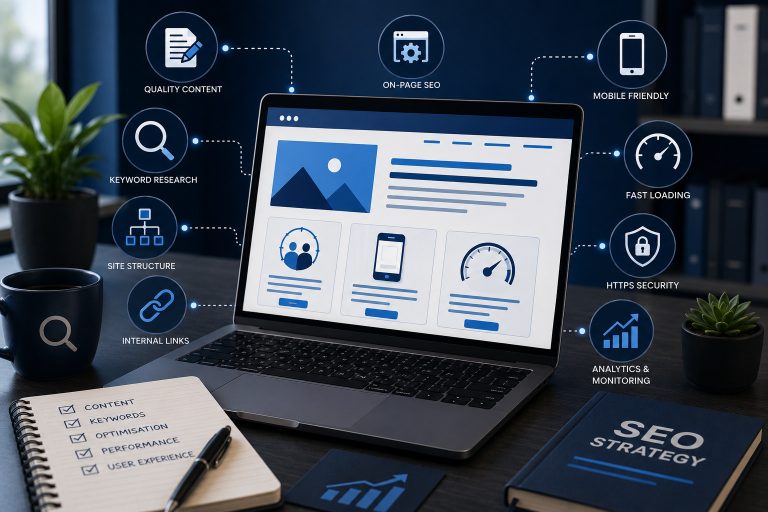
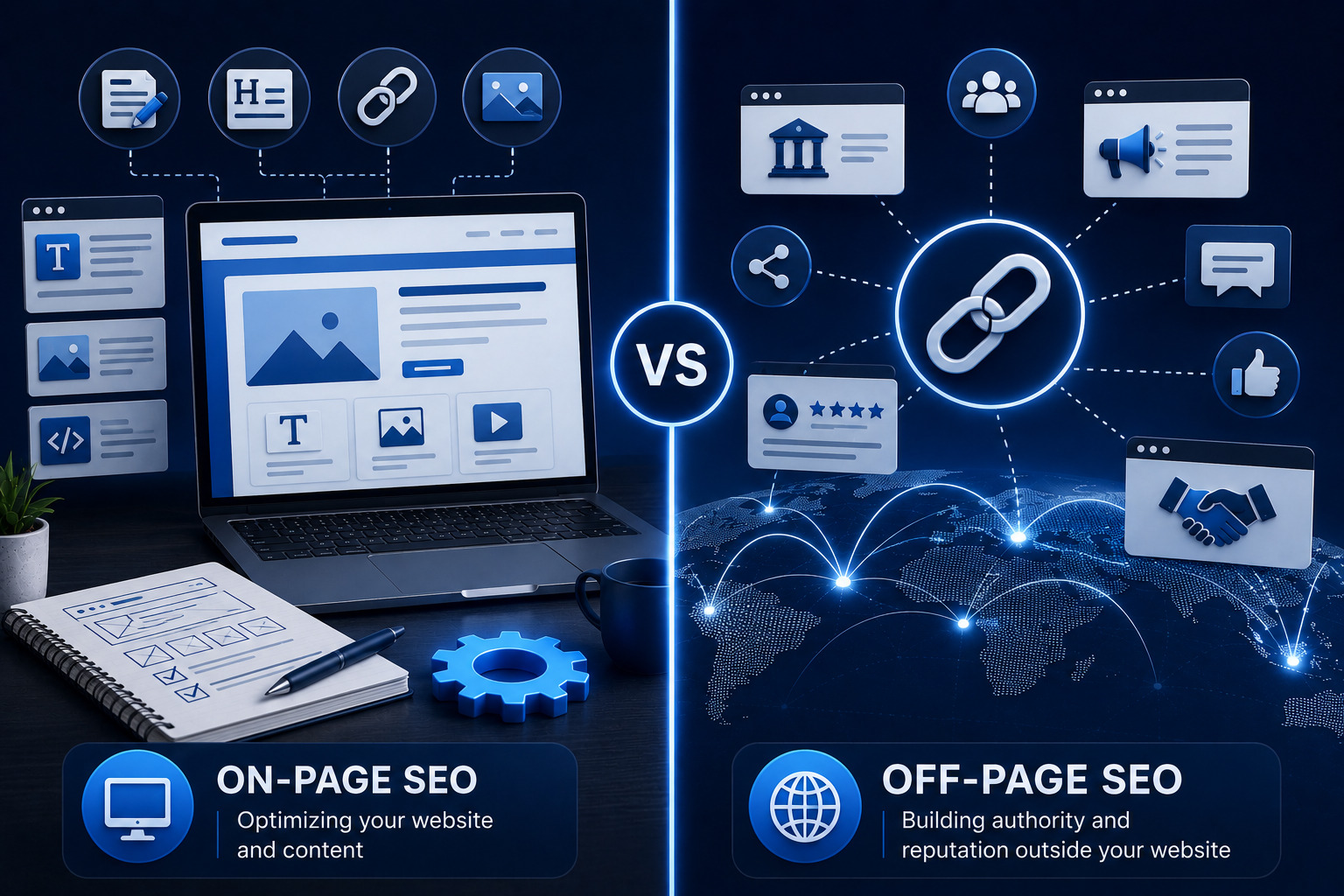

On-page SEO and off-page SEO are two important parts of search engine optimisation. They work together to help search engines understand your website, evaluate its usefulness and determine whether it may be relevant to people searching for particular information, products or services.
On-page SEO focuses mainly on improvements made directly on your website. These include content, page titles, headings, images, URLs, internal links, structured data and the overall organisation of each page.
Off-page SEO focuses on signals and activity outside your website. These may include links from other websites, brand mentions, reviews, digital public relations, industry relationships and the broader reputation of your business online.
This detailed comparison explains the difference between on-page SEO and off-page SEO, how each one works, which activities belong to each category and how businesses can use both to build stronger search visibility.
Quick answer
On-page SEO improves the content, structure and technical elements found directly on your website. Off-page SEO strengthens reputation, authority and external references beyond your website. On-page SEO helps search engines understand your pages, while off-page SEO can provide external signals that other people and organisations recognise your content or business as useful.
On-Page SEO vs Off-Page SEO: The Main Difference
The main difference is where the optimisation work takes place.
On-page SEO involves elements that you can usually control directly through your website. You can edit the page content, update the title, change headings, improve internal links, optimise images and correct technical problems.
Off-page SEO involves how your website and brand are recognised elsewhere online. You cannot directly control whether another reputable website links to you, mentions your brand or publishes a positive review, although your work, relationships and reputation can influence those outcomes.
On-page SEO
Improvements made directly to your website’s pages, content, HTML, navigation, internal links and technical presentation.
Off-page SEO
External signals such as backlinks, mentions, reviews, media coverage, partnerships and online reputation beyond your website.
What Is On-Page SEO?
On-page SEO, sometimes called on-site SEO, is the process of improving individual webpages and the website elements that support them.
The purpose is to make each page clear, useful and accessible to both visitors and search engines.
On-page SEO includes more than placing a keyword in a paragraph. It involves understanding what the user needs, creating suitable content and organising the page so that its purpose is easy to understand.
Examples of on-page SEO include:
- Writing a descriptive page title
- Creating a clear main heading
- Answering the searcher’s question thoroughly
- Using relevant words naturally
- Organising content with subheadings
- Improving page URLs
- Adding internal links
- Optimising image filenames and alt text
- Adding useful structured data
- Improving mobile usability
- Making important links crawlable
- Fixing duplicate or thin content
- Improving page speed
- Creating clear calls to action
On-page SEO is largely within your control
You may not control how a search engine ultimately ranks a page, but you can control the quality, structure and technical condition of the page you publish.
On-page SEO goal
Create a page that clearly satisfies a specific user need while remaining easy for search engines to discover, interpret and index.
What Is Off-Page SEO?
Off-page SEO, sometimes called off-site SEO, includes activity outside your website that can contribute to its visibility, reputation and perceived authority.
Links are one important part of off-page SEO, but they are not the only part.
External reputation can also be influenced by reviews, media coverage, professional associations, brand mentions, community involvement and genuine business relationships.
Examples of off-page SEO include:
- Earning links from relevant websites
- Receiving coverage from news publications
- Being mentioned by industry organisations
- Collecting legitimate customer reviews
- Maintaining accurate business-directory listings
- Participating in professional associations
- Publishing original research that others reference
- Building supplier and partner relationships
- Appearing on podcasts or interviews
- Contributing expert commentary
- Running community or industry initiatives
- Developing a recognisable brand
Off-page SEO depends on trust and relationships
You can request reviews, promote useful resources and build relationships, but another organisation must decide whether your business deserves a link, mention or recommendation.
Off-page SEO goal
Build genuine external recognition and reputation that demonstrates why people and organisations value your website, content or business.
On-Page SEO vs Off-Page SEO: Quick Comparison
| Area | On-Page SEO | Off-Page SEO |
|---|---|---|
| Where it happens | Directly on your website | Outside your website |
| Main purpose | Improve content clarity, relevance and accessibility | Strengthen external reputation and authority |
| Level of control | Mostly under your direct control | Influenced but not completely controlled |
| Main activities | Content, titles, headings, links, images and technical improvements | Backlinks, mentions, reviews, PR and partnerships |
| Primary audience | Website visitors and search engines | External audiences, publishers, customers and organisations |
| Common tools | CMS, Search Console, analytics and SEO auditing tools | PR tools, backlink research, review platforms and media monitoring |
| Main risk | Thin content, poor structure and technical errors | Manipulative links, fake reviews and spammy promotion |
| Best starting point | Usually begin here | Build after the website provides something worth referencing |
The Main Elements of On-Page SEO
Useful content
The page should answer the searcher’s question or support the action they want to complete.
Page titles
The title should be unique, descriptive and accurate.
Headings
Headings should organise the content into logical sections and help readers scan the page.
Search intent
The type of page should match what the user is trying to accomplish.
URLs
URLs should be understandable and stable where possible.
Internal links
Links between related pages help users navigate and help search engines discover content.
Image optimisation
Images should have suitable dimensions, descriptive filenames and appropriate alternative text.
Mobile usability
Pages should function properly on smartphones and tablets.
Website speed
The page should avoid unnecessary delays caused by large images, excessive scripts or weak hosting.
Structured data
Relevant structured data can help search engines understand certain types of content more clearly.
Calls to action
Visitors should understand the next step after reading the page.
The Main Elements of Off-Page SEO
Backlinks
Links from external websites can help search engines discover content and understand relationships between webpages.
Brand mentions
Businesses may be mentioned online without receiving a clickable link. These mentions can still contribute to awareness and reputation.
Reviews
Legitimate customer reviews help potential customers evaluate a business and are particularly important for local organisations.
Digital public relations
Original stories, research, events and expert commentary can generate coverage from relevant publications.
Business listings
Accurate directory and profile information can help customers confirm a company’s details.
Partnerships
Suppliers, professional associations, charities, schools and industry partners may provide legitimate references.
Community participation
Meaningful involvement in local or professional communities can strengthen awareness and create genuine mentions.
Social distribution
Social platforms can expose content to people who may later visit, reference or link to it.
Content Optimisation Is the Foundation of On-Page SEO
Content is one of the most important parts of on-page SEO because search engines need something useful to evaluate and present.
A page should have a clear purpose and answer the user’s need without unnecessary repetition.
Content should match the page type
A service page, product page, comparison article and educational guide serve different purposes.
A user searching for a definition may need an explanatory article, while someone searching to hire a provider may need a service page.
People-first content
Useful content should be written primarily for visitors rather than created only to attract search traffic.
Strong content is generally:
- Accurate
- Relevant
- Clear
- Original where possible
- Written for a specific audience
- Supported by genuine experience
- Updated when information changes
- Easy to navigate
Depth should match the subject
A simple question may require a brief answer, while a complex platform comparison may require a detailed explanation.
Length alone does not make content better. The page should include enough information to satisfy the user without adding sections simply to increase the word count.
Do not create content only for rankings
A page should provide genuine value to the intended audience even if search-engine traffic were not available.
Page Titles and Headings
Page titles
The page title helps users and search engines understand the subject of a page.
A strong title should:
- Accurately describe the page
- Be unique within the website
- Remain clear and concise
- Use relevant language naturally
- Avoid misleading promises
- Include the brand where appropriate
Main headings
The main heading should clearly introduce the topic or purpose of the page.
Subheadings
Subheadings divide long content into manageable sections and help readers identify the information they need.
Do not choose headings only for appearance
Heading levels should represent the content structure rather than being selected only because one size looks attractive.
Title and heading principle
Use clear language that helps people understand what the page contains before and after they open it.
Keywords and Search Intent
Keywords represent the words and phrases people use when searching.
They can help a business understand customer language and identify useful topics.
Use keywords naturally
Relevant phrases may appear in:
- The page title
- The main heading
- Subheadings
- The introduction
- Image alt text where appropriate
- Internal-link text
- The page URL
Avoid keyword stuffing
Repeating the same phrase unnaturally can damage readability and does not guarantee better rankings.
Focus on the underlying need
A search for “best web hosting” may involve commercial research, while “how does web hosting work” is more informational.
The page should satisfy the intent rather than mentioning the keyword repeatedly.
Use related language
A detailed page will naturally include relevant concepts, questions and terminology connected to the topic.
Keyword principle
Use keywords to understand the audience, then build the page around the problem or decision behind the search.
Internal Linking
Internal links connect pages within the same website.
They help visitors explore related information and help search engines discover pages through crawlable links.
Examples of useful internal links
- A hosting guide linking to a shared-hosting comparison
- A WordPress article linking to a WordPress service page
- A product guide linking to relevant product categories
- A blog article linking to a consultation page
- An FAQ page linking to detailed explanations
Use descriptive anchor text
The clickable words should help users understand where the link leads.
Generic phrases such as “click here” provide less context than descriptive text such as “compare managed WordPress hosting and shared hosting.”
Avoid excessive linking
Every sentence does not require a link. Add links when they genuinely help the reader continue their journey.
Link important pages from relevant locations
Pages that are not linked from anywhere on the website may be difficult for users and crawlers to discover.
Internal-linking goal
Create a logical path between related content, services and conversion pages without forcing unnecessary links into every paragraph.
Image Optimisation
Images can improve understanding and make pages more engaging, but poorly prepared files may slow down the website.
Use descriptive filenames
A clear filename can help you organise media and describe the subject more effectively than a random camera filename.
Use appropriate dimensions
Do not upload an extremely large image when it will be displayed in a much smaller area.
Compress images
Compression reduces file size while preserving acceptable visual quality.
Write useful alternative text
Alternative text should describe the purpose or content of a meaningful image for users who cannot see it.
Decorative images may not need descriptive alternative text.
Avoid placing essential text inside images
Important information should normally remain available as real webpage text rather than appearing only inside a graphic.
Use suitable formats
Select the format based on the type of image and the level of browser compatibility required.
Technical Factors That Support On-Page SEO
Some technical SEO work supports individual pages and is often considered part of broader on-page optimisation.
Indexability
Important pages should not be blocked accidentally by noindex directives or authentication requirements.
Canonical URLs
Canonical signals can help identify the preferred version where similar content exists under multiple URLs.
Redirects
Old or removed URLs should redirect to a relevant replacement where appropriate.
HTTP status codes
Pages should return suitable server responses instead of displaying misleading errors.
Mobile usability
The content, navigation, forms and buttons should function properly on smaller screens.
HTTPS
The website should provide a secure connection.
Page experience
Visitors should not encounter intrusive interruptions, unstable layouts or difficult navigation.
Structured data
Correct structured data can help search engines interpret certain content types and may make eligible pages available for richer search appearances.
Technical optimisation is not a substitute for content
A technically clean page still needs to provide relevant and useful information to the intended audience.
Backlinks and Off-Page SEO
A backlink is a link from another website to your website.
Google states that links can help it find new pages and understand relevance.
Not every backlink has equal value
A relevant link from a trusted industry organisation may be more meaningful than many unrelated links from low-quality directories.
Useful ways to earn links
- Publish original research
- Create useful industry guides
- Develop free tools or templates
- Share expert insights
- Publish case studies
- Participate in professional associations
- Contribute to legitimate industry publications
- Support community projects
- Create resources that others genuinely need
Avoid link manipulation
Buying large numbers of links, using automated networks or exchanging links excessively can violate search-engine spam policies.
Paid links should be qualified correctly
Sponsored or commercial links should use suitable link attributes so that the relationship is clear to search engines.
Referral value also matters
A strong external link may send relevant visitors directly to your business even if search rankings were not involved.
Backlink principle
Focus on earning relevant references through valuable work, relationships and resources rather than chasing the highest possible link count.
Brand Mentions and Online Visibility
A brand mention occurs when another website, publication or person discusses your business.
Some mentions include a clickable link, while others mention the company name without linking.
Brand mentions can come from:
- News coverage
- Industry articles
- Customer discussions
- Event partnerships
- Podcasts
- Interviews
- Community programmes
- Supplier websites
- Professional organisations
Monitor your business name
Monitoring mentions can help you identify inaccurate information, customer feedback and opportunities to build relationships.
Do not manufacture fake mentions
Artificial articles, fake profiles and low-quality press releases may provide little genuine business value.
Reviews and Business Reputation
Reviews help potential customers understand other people’s experiences with a business.
They are particularly important for local businesses, service providers and online stores.
Request reviews ethically
Businesses can invite genuine customers to provide feedback after receiving a service or product.
Do not purchase fake reviews
Fake reviews can violate platform policies, damage trust and create legal or reputational risk.
Respond professionally
Responses should remain polite and constructive, especially when the review is negative.
Use feedback to improve the business
Repeated complaints may reveal a genuine service, communication or delivery problem.
Keep business information accurate
Google advises businesses to maintain correct and complete profile information to support local visibility and help customers find them.
Review principle
Build a reputation by delivering a strong customer experience and making it easy for genuine customers to share honest feedback.
Digital PR, Partnerships and Authority
Digital public relations involves creating stories, resources or insights that publications and audiences may find worth discussing.
Digital PR opportunities include:
- Original industry research
- Business surveys
- Expert commentary
- Community initiatives
- Events
- Product launches
- Educational campaigns
- Case studies
- Data visualisations
- Industry predictions
Partnerships can create genuine references
A business may receive links or mentions from:
- Suppliers
- Clients
- Charities
- Schools
- Professional associations
- Chambers of commerce
- Event organisers
- Technology partners
The relationship should be real
A legitimate partnership provides business value beyond receiving a link.
Expert contributions should be useful
Contributing an article or quotation to a relevant publication can build reputation when the contribution is genuinely informative rather than promotional spam.
Where Does Local SEO Fit?
Local SEO combines on-page and off-page activity.
Local on-page SEO may include:
- Clear location information
- Service-area pages
- Local telephone numbers
- Opening hours
- Location-specific service information
- Directions and maps
- Local structured data
Local off-page SEO may include:
- Google Business Profile
- Customer reviews
- Local directories
- Local-news mentions
- Community partnerships
- Professional associations
- Consistent business details
Local ranking involves several factors
Google explains that local results are mainly based on relevance, distance and prominence.
A business cannot control a customer’s location, but it can improve the accuracy, completeness and relevance of its information.
Local SEO principle
Combine accurate website information with a complete business profile, genuine reviews and relevant local relationships.
Is On-Page SEO or Off-Page SEO More Important?
Both are important, but most websites should begin with on-page SEO.
There is little value in earning links to pages that are confusing, outdated, inaccessible or unable to convert visitors.
Why on-page SEO usually comes first
- You control it directly
- It helps search engines understand the page
- It improves the visitor experience
- It creates content worth sharing
- It supports conversions
- It provides a foundation for external promotion
Why off-page SEO still matters
Strong pages may struggle in competitive markets when the website has little external recognition or reputation.
Relevant backlinks, mentions and reviews can differentiate one useful website from many similar competitors.
The importance varies by market
A specialised local service may need fewer external signals than a company competing internationally for broad commercial terms.
Which should you prioritise?
Build a strong website and useful content first, then strengthen external recognition through genuine links, reviews, partnerships and public relations.
How On-Page and Off-Page SEO Work Together
On-page and off-page SEO should support one another rather than operate as separate campaigns.
Example 1: A useful research article
The business publishes an original industry report with clear headings, data, images and internal links.
Other publications find the report useful and reference it in their own articles.
The on-page work makes the resource understandable, while the off-page references expand its reach and authority.
Example 2: A local service page
A company creates a clear page explaining the service, location, process, pricing approach and contact options.
The business also maintains accurate profiles, earns genuine reviews and participates in local organisations.
Example 3: An e-commerce buying guide
An online store publishes a detailed guide comparing products and links naturally to suitable categories.
Industry bloggers and customers share the guide because it helps people choose the right product.
Example 4: A professional case study
An agency publishes a case study explaining the client’s challenge, process and measurable outcome.
The client links to the project from its own website and shares it through professional networks.
The combined effect
On-page SEO creates the useful destination, while off-page SEO helps people discover, discuss and recommend it.
Common On-Page and Off-Page SEO Mistakes
On-page mistake 1: Keyword stuffing
Repeating exact keywords unnaturally makes content difficult to read.
On-page mistake 2: Thin content
A page may mention the topic but fail to answer important customer questions.
On-page mistake 3: Duplicate pages
Creating many nearly identical pages can confuse visitors and make the website difficult to manage.
On-page mistake 4: Weak internal linking
Important pages may remain isolated and difficult to discover.
On-page mistake 5: Ignoring mobile users
Menus, forms and tables may fail on small screens.
On-page mistake 6: Missing conversion paths
The page attracts visitors but provides no clear next step.
Off-page mistake 1: Buying bulk backlinks
Cheap link packages commonly place links on unrelated or low-quality websites.
Off-page mistake 2: Using fake reviews
Fabricated feedback can violate platform policies and damage trust.
Off-page mistake 3: Irrelevant directory submissions
Submitting the business to hundreds of unrelated directories may provide little value.
Off-page mistake 4: Excessive link exchanges
Large-scale reciprocal linking intended mainly to manipulate rankings can create risk.
Off-page mistake 5: Ignoring brand reputation
A business may focus only on links while customers encounter unresolved complaints or inaccurate information.
Off-page mistake 6: Promoting weak content
Public relations and outreach are unlikely to succeed when the destination page provides little value.
Do not build links faster than you build trust
External promotion should reflect genuine business activity, expertise and relationships rather than artificial attempts to manufacture authority.
How to Build a Balanced SEO Strategy
Step 1: Audit the website
Review technical issues, content quality, titles, headings, internal links, mobile usability and conversion paths.
Step 2: Identify important pages
Prioritise pages connected to your main services, products and business goals.
Step 3: Understand search intent
Determine whether each target audience needs a guide, service page, product page, comparison or local page.
Step 4: Improve on-page content
Make each page accurate, useful and clearly organised.
Step 5: Build topic relationships
Connect related articles, resources, products and services through internal links.
Step 6: Create link-worthy resources
Develop research, tools, templates, guides and case studies that external audiences may genuinely reference.
Step 7: Strengthen business profiles
Maintain accurate business information, local listings and social profiles.
Step 8: Request genuine reviews
Invite real customers to share honest feedback without offering misleading incentives.
Step 9: Build industry relationships
Participate in relevant associations, events, partnerships and community projects.
Step 10: Measure results
Monitor impressions, clicks, links, referral traffic, reviews, enquiries and sales.
Step 11: Review quality regularly
Update outdated pages, repair broken links and improve content based on customer questions and performance.
On-Page and Off-Page SEO Checklist
On-page SEO checklist
- Clear search intent
- Useful page content
- Unique page title
- Logical heading structure
- Readable page layout
- Descriptive URL
- Optimised images
- Relevant internal links
- Mobile-friendly design
- Secure HTTPS connection
- Suitable structured data
- Clear call to action
Off-page SEO checklist
- Accurate business profiles
- Genuine customer reviews
- Relevant backlinks
- Industry mentions
- Professional associations
- Digital PR opportunities
- Supplier and client partnerships
- Community involvement
- Brand-mention monitoring
- Ethical link practices
- Consistent business details
- Referral traffic monitoring
Final Verdict: What Is the Difference Between On-Page and Off-Page SEO?
On-page SEO focuses on the content, structure and technical elements found directly on your website.
Off-page SEO focuses on how your website and business are recognised outside your own domain through links, reviews, mentions, partnerships and reputation.
On-page SEO is usually the best place to begin because it is largely under your control and creates the foundation visitors and external websites interact with.
Off-page SEO becomes more effective when your business provides strong services, useful content and resources worth recommending.
Neither area should be treated as a shortcut. Strong SEO combines helpful webpages with genuine reputation and external recognition.
Our recommendation
Start by improving your website’s most important pages, content, internal links and technical accessibility. Then build external authority through valuable resources, genuine relationships, customer reviews, relevant mentions and ethical link earning.
Frequently Asked Questions
What is on-page SEO?
On-page SEO is the process of improving content, titles, headings, images, internal links, URLs and other elements found directly on a website.
What is off-page SEO?
Off-page SEO includes external activities and signals such as backlinks, brand mentions, reviews, digital PR and business partnerships.
What is the main difference between on-page and off-page SEO?
On-page SEO takes place directly on your website, while off-page SEO involves reputation and references from sources outside your website.
Which is more important, on-page or off-page SEO?
Both are important. Most websites should begin with on-page SEO because strong content and structure provide the foundation for earning external links and recognition.
Are backlinks part of on-page SEO?
External backlinks are part of off-page SEO. Internal links between pages on your own website are generally considered part of on-page SEO.
Are social-media posts part of off-page SEO?
Social-media activity can increase content exposure, brand awareness and referral traffic. Social engagement does not automatically guarantee stronger search rankings.
Are reviews part of off-page SEO?
Yes. Reviews contribute to external business reputation and are especially important for local businesses and customer decision-making.
How can I improve on-page SEO?
Improve search intent, content quality, titles, headings, internal links, images, mobile usability, page speed and conversion paths.
How can I improve off-page SEO?
Create useful resources, request genuine reviews, build professional relationships, earn relevant mentions and participate in legitimate digital PR and community activity.
Can I buy backlinks?
Buying links intended to manipulate rankings can violate search-engine spam policies. Focus on earning relevant links through valuable content, expertise and genuine relationships.
Does a website need off-page SEO to rank?
The amount of external recognition required depends on competition, topic and market. Strong on-page SEO may be enough for some specialised searches, while competitive markets often require stronger authority and reputation.
Is technical SEO part of on-page SEO?
Technical SEO is often treated as a separate category, but many technical elements directly affect individual pages and support on-page performance.
How long does on-page SEO take to work?
Some technical and content improvements can be recognised after search engines recrawl the website, but meaningful performance changes depend on competition, authority and the quality of the work.
How long does off-page SEO take?
Building genuine reputation, links and relationships usually takes time. Artificially accelerating the process through spammy tactics can create risk.
Can an SEO plugin handle on-page SEO automatically?
An SEO plugin can help manage metadata, sitemaps and technical settings, but it cannot automatically understand your customers, write expert content or build a strong business reputation.
Need Help Improving Your On-Page and Off-Page SEO?
A strong SEO strategy requires useful website content, clear technical structure and a trustworthy online reputation. Teemikemedia Agency helps businesses improve their website structure, content, internal linking, local visibility and broader search presence.
Official references
This article was prepared using current guidance from Google Search Central and Google Business Profile. Search systems, policies and supported features may change, so review current official documentation when planning SEO activity.
Creating helpful, reliable, people-first content